This is an old revision of the document!
Punctuation Matters
Naked Apostrophes
I have recently become somewhat embroiled in a bit of controversy over the correct form of possessive to use when dealing with singular nouns and names that end in single-s: I thought it might be worth documenting my viewpoint and the justification for it. First things first, then: in the 1970s my grammar school taught me a very simple, three-part rule:
- Words ending in not-s (e.g., bell) take apostrophe-s: The bell's chime was clear.
- Words ending in double-s (e.g., princess take apostrophe-s: The princess's dress was blue.
- Words ending in single-s (e.g., bus) take apostrophe only: The bus' route was blocked.
This is indeed coded into my music player Giocoso, with code I first wrote back in 2019:
# For apostrophes, if a word ends in single-s, add only an apostrophe. If it ends in ss or not in s at all, then it's apostrophe+s.
if [[ ! -z $displaycomp ]]; then
    if [[ ${displaycomp: -2} == ss ]]; then
      displayapostrophe="'s"
    elif [[ ${displaycomp: -1} == s ]]; then
      displayapostrophe="'"
    else
      displayapostrophe="'s"
    fi
  else
    displayapostrophe=""      # If, for some reason, they are playing un-tagged FLACs directly, then we can't be displaying this at all
  fi
This code is why you'll see this sort of thing when playing music with Giocoso:
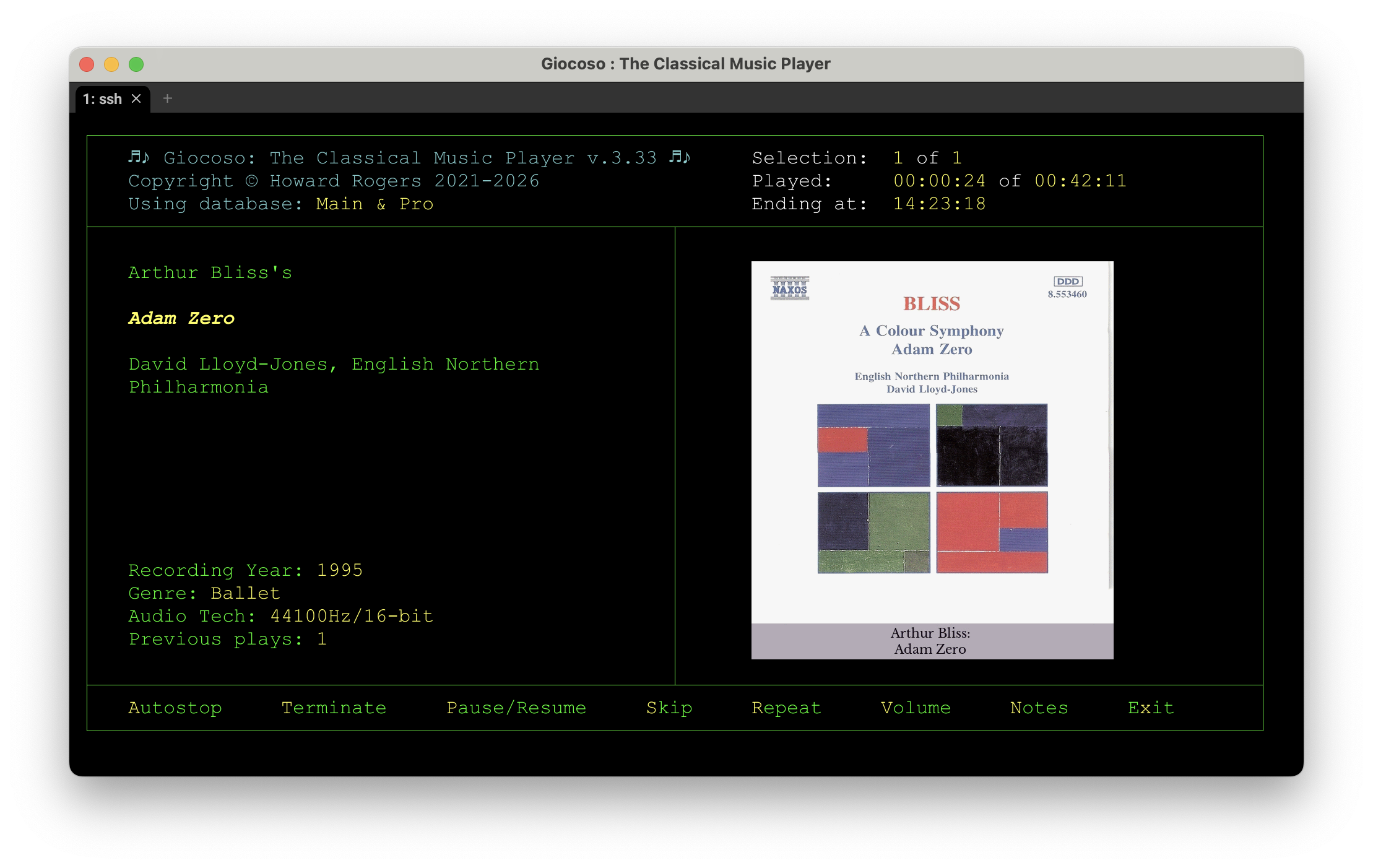
Or this:
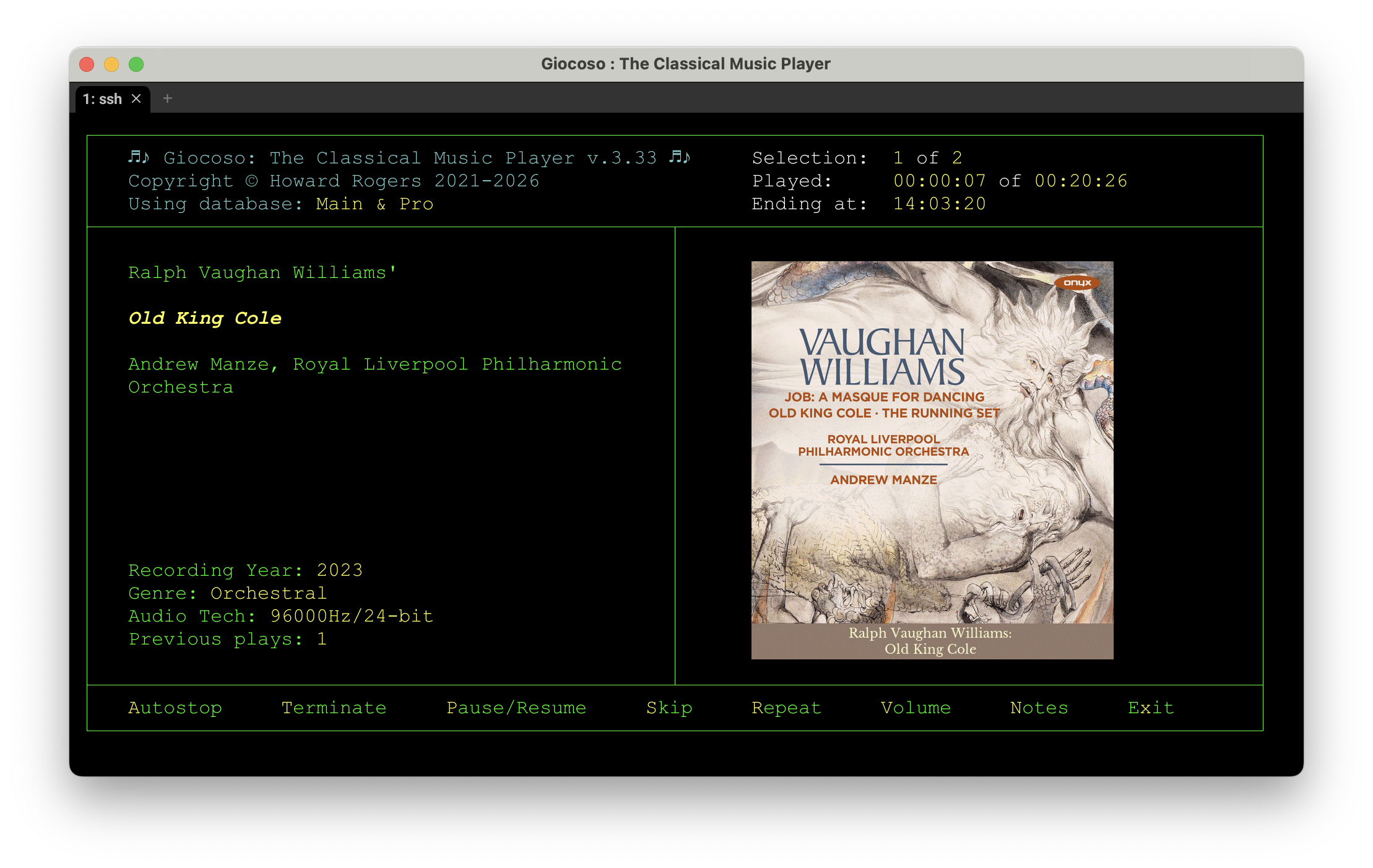
Arthur Bliss ends in double-s, so he gets an apostrophe-s, but Ralph Vaughan Williams ends in single-s, so he gets a naked apostrophe to indicate possession.
It is possible, of course, that I was taught extremely badly back in the 1970s (and it's also very likely that fashions have changed since those days). However, I checked what (vaguely) current authorities on the matter have to say.
First, we have New Hart's Rules, OUP, 2014: The Oxford Style Guide, p.71
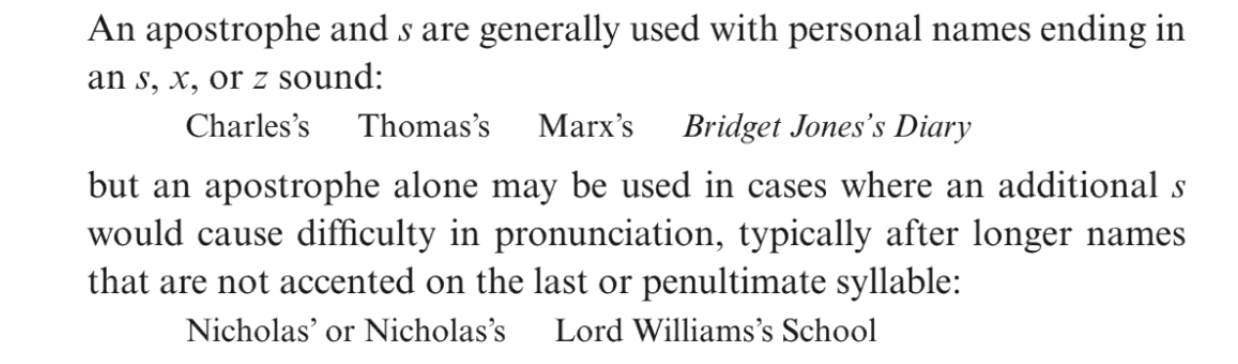
This is certainly more nuanced than the rule I was taught. Indeed, with the example given of “Lord Williams's School” it appears to flat-out say my rule is simply wrong. Except that it does no such thing: if it gives the example of Nicholas' and Nicholas's, it's showing that either form is acceptable. I cannot see a meaningful difference between the name “Nicholas” and “Williams”: both are three-syllable names ending in single-s, so what applies to Nicholas should equally apply to Williams.
We shouldn't, in any case, look for a rule spelled out that simply mandates or forbids the naked apostrophe. The point is to demonstrate that a formidable authority on punctuation has just demonstrated that the naked apostrophe is acceptable “where an additional s would cause difficulty in pronunciation”. It is, in other words, more a matter of 'internal voicing' that occurs when you read than a hard-and-fast rule-book approach.
This well-known hospital would, for example, probably want to take issue with their advice on 'personal names ending in s':
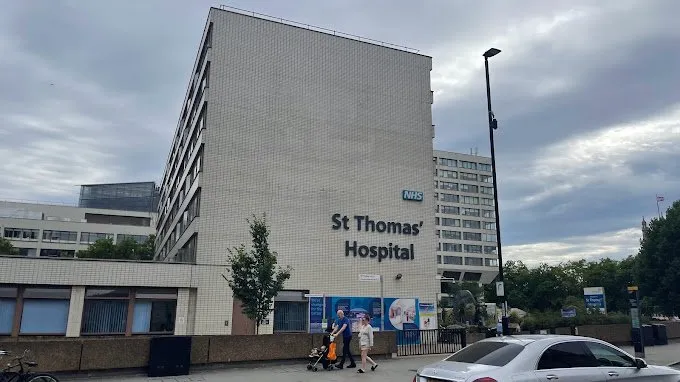
Anyway: the New Hart's Rules permits naked apostrophes for singular names that end in s. It doesn't compel their use but it doesn't ban them, either.
My second authority is The Oxford Guide to Style, published in 2002. On page 113 we find:
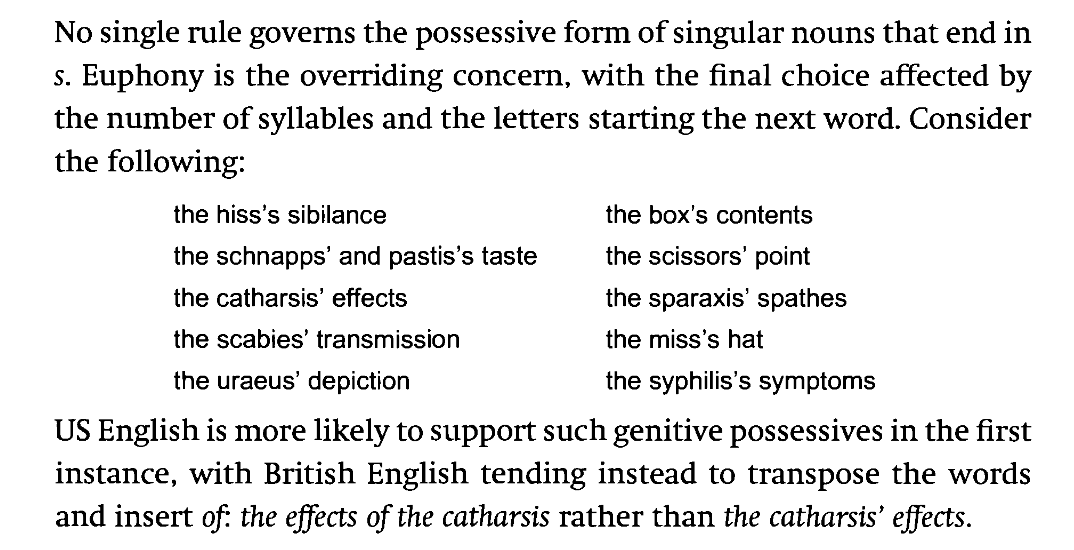
Almost all these examples (why syphillis should be unique, I have no idea!) support the idea that words ending in single-s get a naked apostrophe when forming the possessive. More importantly, however, is the statement that there is no hard-and-fast rule but that “euphony is the overriding concern”, again making the point that it is the pleasing nature of your 'inner voice' as you read that determines whether a naked apostrophe is acceptable or not.
Which brings me to my inner voice, I guess! When I read of “Vaughan Williams' symphonies”, I do not pronounce it in my head (and never have) as “Vaughan Williamz-iz symphonies”. The extra syllable is, for me, redundant. I hear it as simply “Vaughan Williams Symphonies”, with the middle word pronounced as three syllables, not four. I am not claiming that other people don't 'hear' it with the extra “-iz”: if they wish to type “Vaughan Williams's symphonies”, they're not wrong to do so, if that's how their 'inner voice' works. Whatever is euphonious to someone is correct: I just happen to find the extra syllable jarring and ugly.
It is probably fair to say that I am somewhat old-fashioned in this, however: it's quite difficult to find, quickly, examples of modern literature that do it 'my way'. I can always find plenty of examples from the past that agree with me, of course:
- A dog—old Carlo, Mr. Rivers’ pointer, as I saw in a moment—was pushing the gate with his nose, and St. John himself leant upon it with folded arms; his brow knit, his gaze, grave almost to displeasure, fixed on me. I asked him to come in. (Charlotte Brontë, Jane Eyre (1847), Chapter 31)
- “I am an archer of my lord Douglas’ outer guard. I can have no promotion save from him or those of his house — not even from the King himself.” (S.R. Crockett, The Black Douglas (1899), Chapter VIII)
Somewhat more modern, though:
- A cloud began to cover the sun slowly, wholly, shadowing the bay in deeper green. It lay beneath him, a bowl of bitter waters. Fergus’ song: I sang it alone in the house, holding down the long dark chords. (James Joyce, Ulysses (1921), Chapter 1)
This time, something a little more specifically relevant to music and to Vaughan Williams specifically:
- I can think of the complete Matthew Passion, Brahms’ Requiem, and works like Parry's Job and Vaughan Williams’ Sea Symphony… (Adrian Boult, My Own Trumpet, 1973, Page 51)
- April 1935 saw the first performance of Vaughan Williams’ F minor Symphony… (Adrian Boult, My Own Trumpet, 1973, Page 106)
- Vaughan Williams’ Job made a deep impression, helped perhaps by my idea of putting up some large cards with numbers, which showed the nine scenes, so that the audience could follow dramatically as well as musically. (Adrian Boult, My Own Trumpet, 1973, Page 138)
And finally, something equally relevant to music, but from Benjamin Britten:
- …you know how I dislike conducting. But because of Krips’ sudden defaulting I had to take on Budd… (Reed, Cooke & Mitchell, Letters from a Life, Volume 4, Page 42, quoting Britten letter 728 written March 1952).
Anyway: my point remains, there's ample support for using the naked apostrophe on names ending in single-s, in both grammatical authority and literature, including literature that is specifically musically- and Vaughan Williams-related. It's not a requirement, but a personal preference, depending on one's sense of 'euphony'.
Commas
While we're on punctuation matters, I'd also like to throw this in:
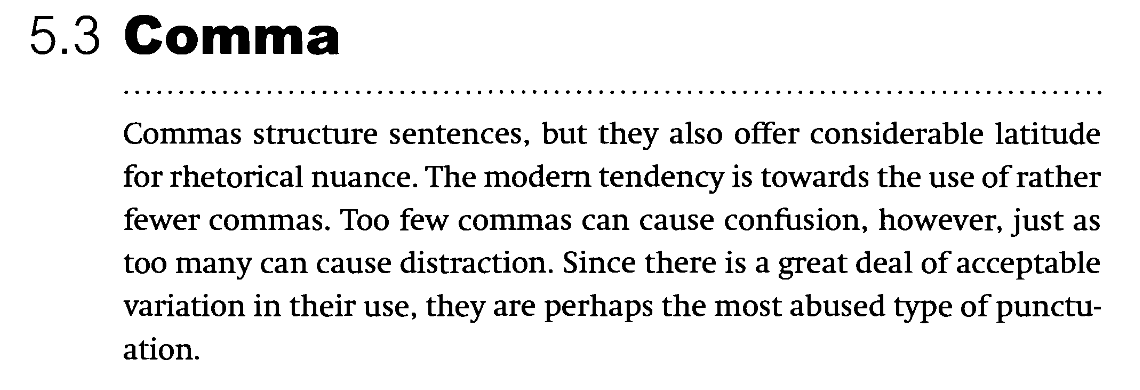
That's from the same Oxford Style Guide (2002) as before, this time page 117. It again acknowledges that there is no single, hard-and-fast rule on the acceptable use of the comma: it is a matter of fashion as much as anything and 'best comma practice' is a moveable feast. My own personal approach to them, again taught back in the 1970s, is to never use them before conjunctions and to avoid excessive 'slow down' commas — that is, commas whose function is to exhibit the writer's sense of pacing and breath-drawing which may not match my own. Generally, I prefer to let the reader parse things as they wish or need… but again: it's all to do with 'inner voicing' as one reads, not blind application of a simplistic grammar rule.
Lest I be accused of selective quoting, let me make it clear that the Oxford Style Guide goes on to recommend the use of commas before conjunctions:
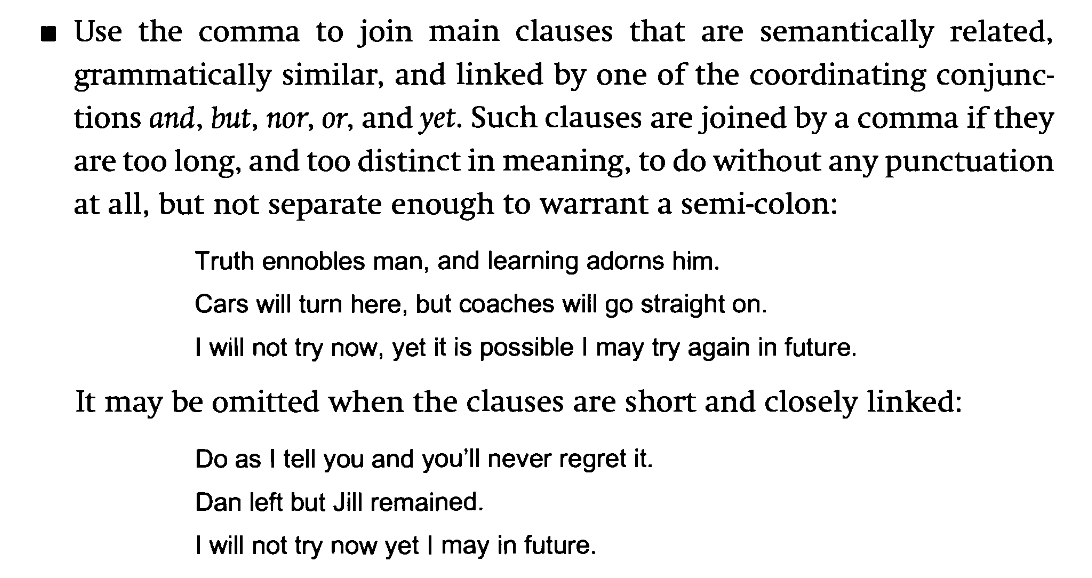
My reaction to that is that it's an awfully convoluted rule to state and difficult to apply: you have to assess whether main clauses are 'semantically related', 'grammatically similar' and 'too long', which is an incredibly subjective thing to determine, I would say. Of the first three examples shown, with commas, I would dispose of the comma in the first two. The third one (“I will not try now, yet it is possible…”) I think is just ugly writing. I would re-write it to be “I will not try now. It is possible I may try again in future”. The second set of three examples are, I think, how I would generally try to write: I wouldn't reserve that comma-less approach for just 'short and closely linked' clauses. Interesting that the last example cited is practically a verbatim re-write of the third but without the comma: I think it proves that the comma in that third example is really unnecessary and thereby demonstrating that comma usage is a matter of taste as much as anything else.
It has been said to me directly that commas are necessary to structure a complex sentence properly. They may well be: but my response to that assertion was and remains that you shouldn't be writing sentences so complex that their meaning necessitates numerous commas in the first place. At best, they will make your prose slower to read; at worst, they will not resolve ambiguities that your convoluted prose wraps in a tangle of clauses and sub-clauses. Epithetically: write more simply; need fewer commas.
The Oxford Comma
Of course, the Oxford Style Guide is going to recommend the use of the Oxford Comma (or 'serial comma' as it's sometimes called), too:
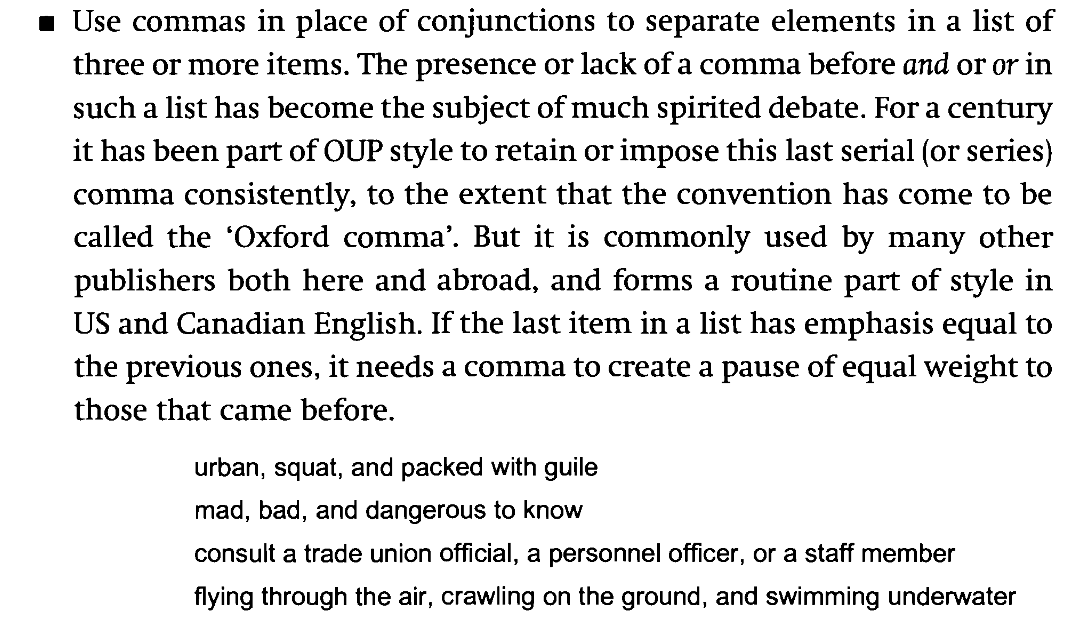
I cannot stand the Oxford Comma: for me and my 'inner voice', the presence of that last comma in the list just enforces a pause that is completely unnecessary: there's nothing wrong with 'urban, squat and packed with guile'. There's no ambiguity about what's meant and I'd much prefer to get on to the end of the sentence than have a visual instruction to halt momentarily for no good reason. Putting it bluntly, I find the Oxford Comma slows down reading by introducing visual clues to pause for no good reason.
Sometimes, removing the comma would give rise to confusion. A dedication of a book that read To my parents, Mother Teresa and the pope certainly suggests that the author has two illustrious parents, neither of whom should really be having children at all, let alone together! The suggestion is that re-writing that as To my parents, Mother Teresa, and the pope makes it clear that three separate dedicatees are intended. I don't completely buy that argument but I can certainly agree that the slight, momentary pause introduced before the Pope is mentioned helps makes it a little less problematic. My personal preference would be to re-phrase the dedication completely, however (for example: To my parents, to Mother Teresa and to the Pope).
In the general case, removing an Oxford Comma may need a sentence to be lightly re-worded to make it retain sense and specificity. I think writing is clearer (and more euphonious) when the Oxford Comma is disposed of and I rather suspect that's why the in-house style guides of both The Times newspaper and the The Economist magazine say not to use it. Plenty of other style guides do recommend it, of course: I'm not suggesting otherwise. I am suggesting merely that it is as valid to dispense with it as to retain it.
In conclusion, therefore: naked apostrophes, comma abuse in general and the use of the Oxford Comma specifically are matters of taste and 'inner ear', not ones of rule-book rigour. I do not, in other words, claim that, “I am right” but merely assert that, “I am not wrong”.