Compositions-at-Once!
 It's quite common to see in, say, YouTube comments these days that people still prefer to use physical media for their classical music listening pleasure rather than any of the streaming, YouTube or similar 'consume-but-don't-own' musical options available these days.
I agree with that sentiment in one sense: I hate streaming music. If I don't own it, it doesn't really 'count' in my mind. If I own it, I curate it and maintain it and make sure it's metadata is accurate and so on; if I merely 'consume' it, I have no idea whether all that's being done correctly or not (but can be pretty confident that as it's classical music we're talking about, it won't have been!)
So, though this site and my personal preferences are all about ripping music off a CD, I get and agree with the 'ownership' angle of the original proposition.
The trouble I have with CDs is that they split music into multiple tracks -and we then tend to rip them per track, and thus we end up with digital music players that can play the Adagio from that symphony, and the Presto from that concerto…. and we think nothing of it, because that's just the way it's always been with recorded music, right?
Wrong!
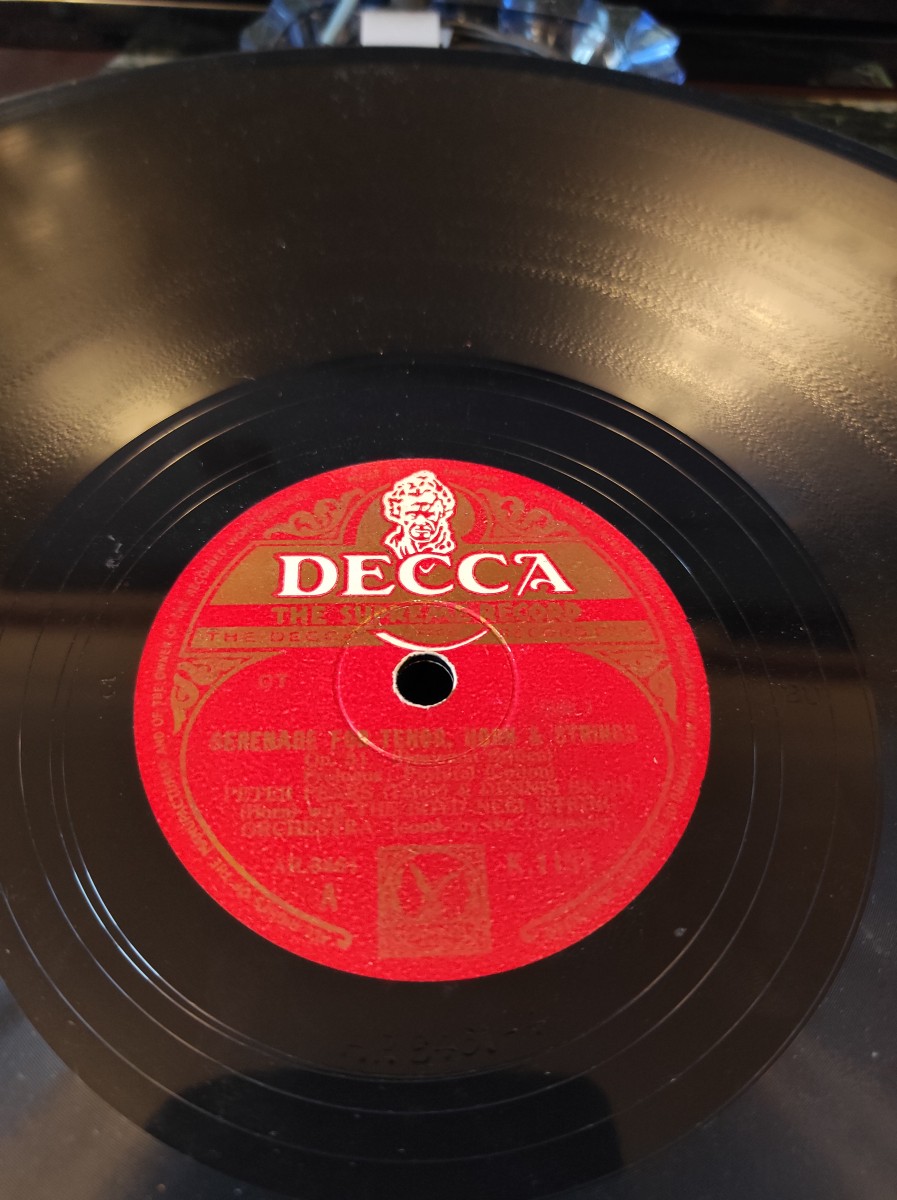
That's a photo of my highly-prized and beloved 78rpm first edition of Benjamin Britten's 1943 masterpiece, Serenade for Tenor, Horn and Strings: the recording was made in 1944.
The Serenade has several 'movements': lovely settings of poems by various authors, concerning moonlight, evening, fears about night and so on. The six poems are prefaced by a haunting prologue for natural horn and suffixed by an equally haunting epilogue.
Looking at the picture of the shellac disc containing this work, however, can you see any evidence of this piece being comprised of six separate poems? No: the grooves obviously reflect light differently at different places, reflecting where the music gets louder and softer… but there's no actual, physical compartmentalisation of the music at all.
Meaning that in 1944, if you wanted to hear the Serenade, you had to hear it as a continuous stream of music, not as separate poems or movements.
Naturally, there are pauses between the poems: the players need to get themselves into gear for what's coming and both the conductor and tenor could probably do with a bit of a breather… but, a few seconds of pause doesn't really count as a 'break' in my view.
Of course, being a 78rpm disk, you could only fit about 4 minutes of music on each side of the record in any case -so, in fact, the 'big breaks' really kick in, not by physical separation of tracks on a side of disk, but by you having to get up and turn over the disk to allow play to continue. There are six sides of shellac record for this work, which represents one side per poem. So in that sense, I guess you could say that the recorded music listening experience was broken up into separate 'bits', each bit representing one poem setting. But even though I acknowledge that, you'll note that the prologue and epilogue do not get separate sides or separate 'tracks'.
What about the LPs that came after the 78s? Surely, they split things up into tracks? In my mind, I felt sure they did… but I was again wrong!
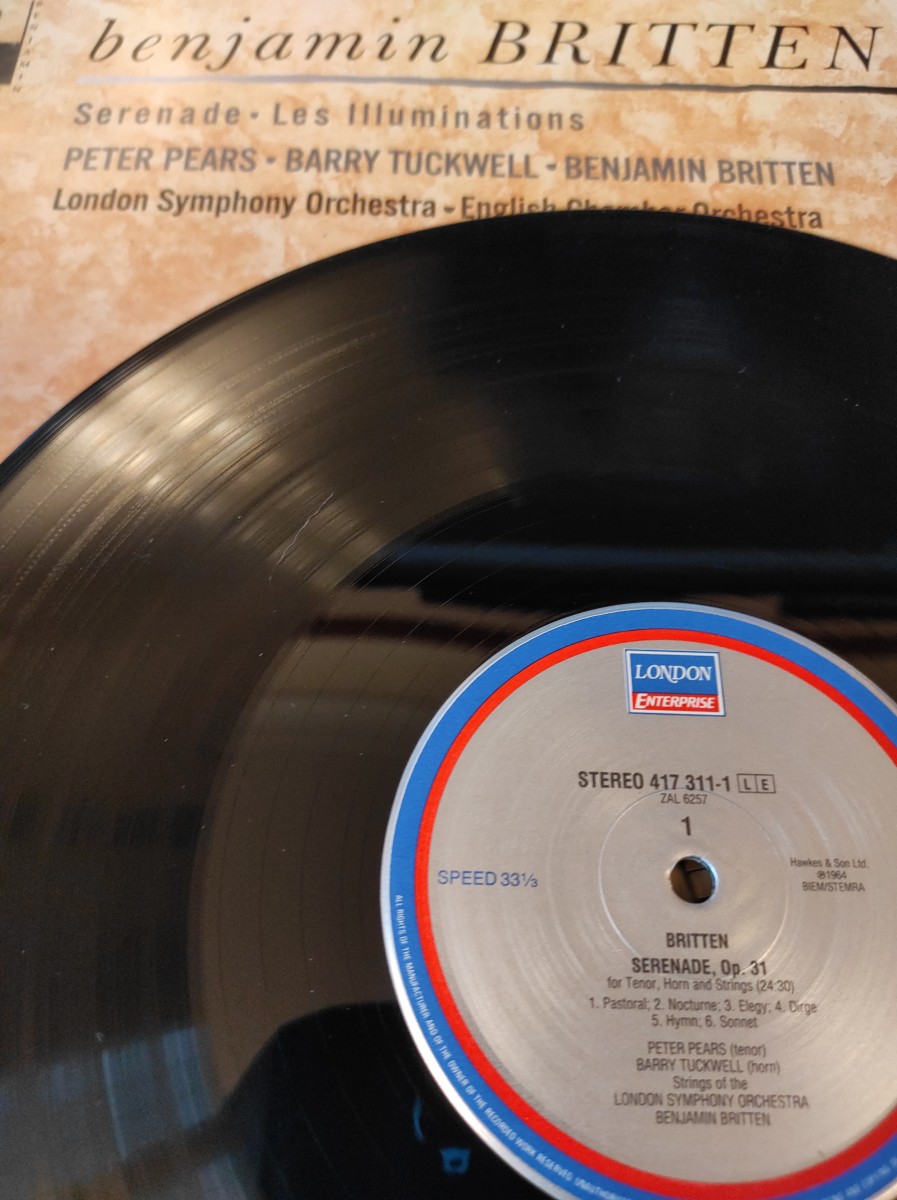
Here, you see my pristine (but rather dusty!) LP of the same Serenade for Tenor, Horn and Strings piece, though a copyright notice on the sleeve tells me that it dates from at least 1986.
Do you notice six separate tracks on this disk?
No. Because there simply aren't any. It perhaps looks like that there are separated tracks because again the light is reflected at different points differently, depending on the changing loudness, orchestral density and so on. But I can promise you… there are no separated tracks… despite, you'll notice, the central label clearly that there are six 'movements', starting with '1. Pastoral' and ending at '6. Sonnet' (or, at least, it would be clear if I was better at taking photographs!)
So as late as 1986, if you wanted to listen to Britten's masterpiece, you really did now have to start at the beginning and keep going until the end -for now, everything fits on one side of an LP and you don't even get the breaks that came about by having to turn the disk over any more!
So now we move into the really digital, CD era -roughly around the mid-1980s or early 1990s. What happened when I re-bought the recording then?
Well, this:
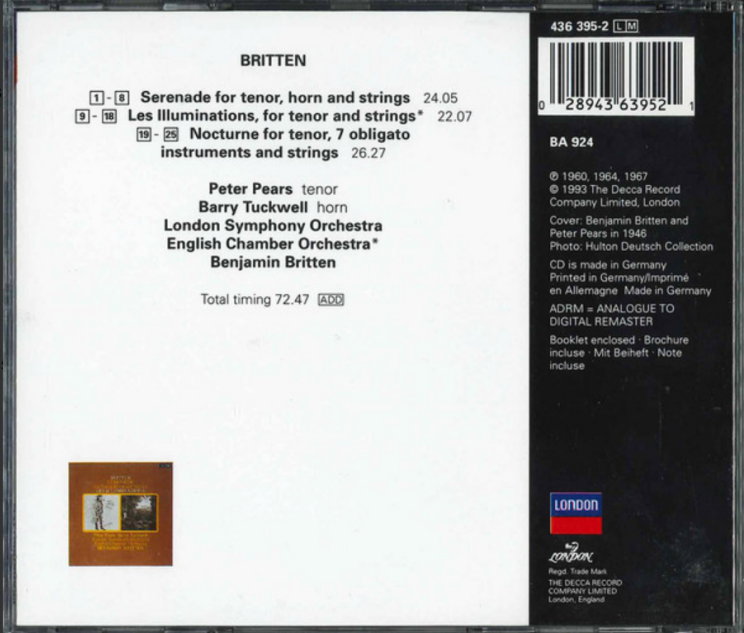
You'll notice the date over on the blurry right: no earlier than 1993. And the Serenade has suddenly morphed into a piece of eight separate tracks! Not even six, one per poem! No, on this release, even the horn prologue and epilogue are treated to their own index mark.
Why on Earth did someone in the early 1990s ever think that what was written as a single work, and was sold as a single work for nigh-on 45 years, should suddenly be shipped in 8 separate 'pieces'?! My mind boggles at the abruptness of it all, really.
Now, naturally, it being a CD, the playback from one track to another will be seamless and therefore the overall effect is of the work still being supplied as a single, organic whole. But the mere existence of track points (or index marks… call them what you will) means that it's now possible to play just the Sonnet, or to keep repeat-playing the Hymn (for example), for the first time ever. By merely providing the technology to break the work into pieces, the CD manufacturers have encouraged us to think of music as coming in little pieces, rather than large, whole compositions -because you could now do something that even as recently as 1986, you couldn't do. (Dropping a stylus at random points onto the playing surface in the hope you hit the right spot doesn't count as an equivalent experience, by the way!)
Fundamentally, then, I ask the question: when did it become acceptable to supply a 3-Symphony CD with 12 tracks rather than 3 (i.e., one per symphonic movement, rather than 1 per symphony)?
There's no real answer, of course -and, as has been pointed out to me, index marks can be quite useful …for skipping boring bits, repeating the good bits… and a whole host of other reasons which (to my mind) simply fly in the face of how we used to listen to music and how we're really supposed to listen to music (classical music, at least).
The problems in my view are magnified when you rip CDs to digital audio files. For starters, you've potentially got dozens of files (for a large oratorio, say), when “ideally” you'd really only have 3 or 4 (one per 'part' or 'Act'). Multiply by lots of CDs, and you end up managing a collection of (in my case) 65,000 “tracks” rather than around 10,000 “compositions”. Every media player generally available, too, will present your music to you like this:
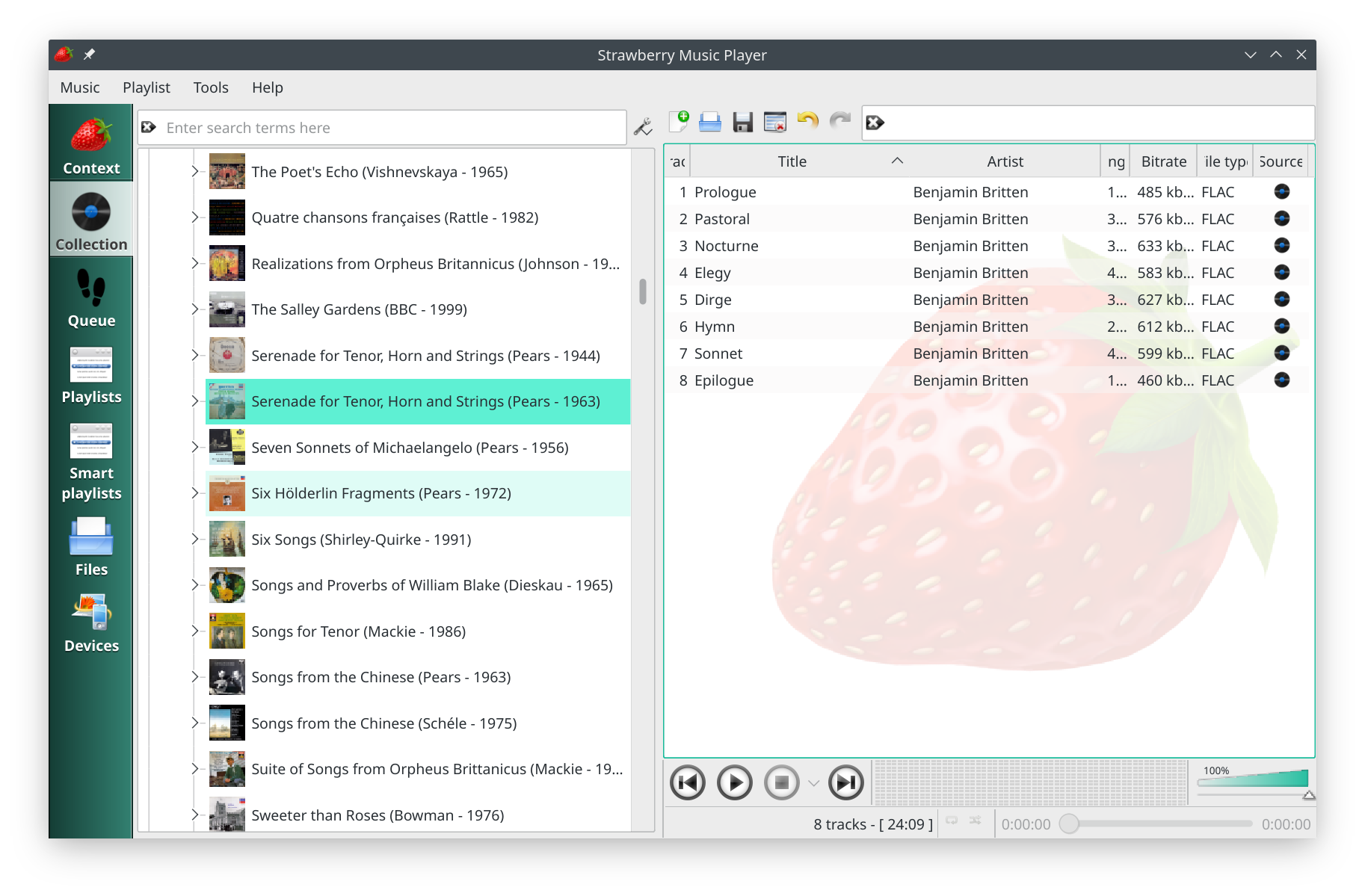
..as fragments of something, each with as much right to be heard as the other… and with play and pause buttons so you can stop-and-start your way through a piece that (presumably) the composer intended you to hear from beginning to end without major interruption (and which is precisely how you'd hear it if you attended a concert, for example).
Incidentally, I also deplore an equivalent tendency for otherwise-respectable radio stations to play merely 'bits' of something, rather than the whole. Take this random grab of Classic.fm's current playlist:
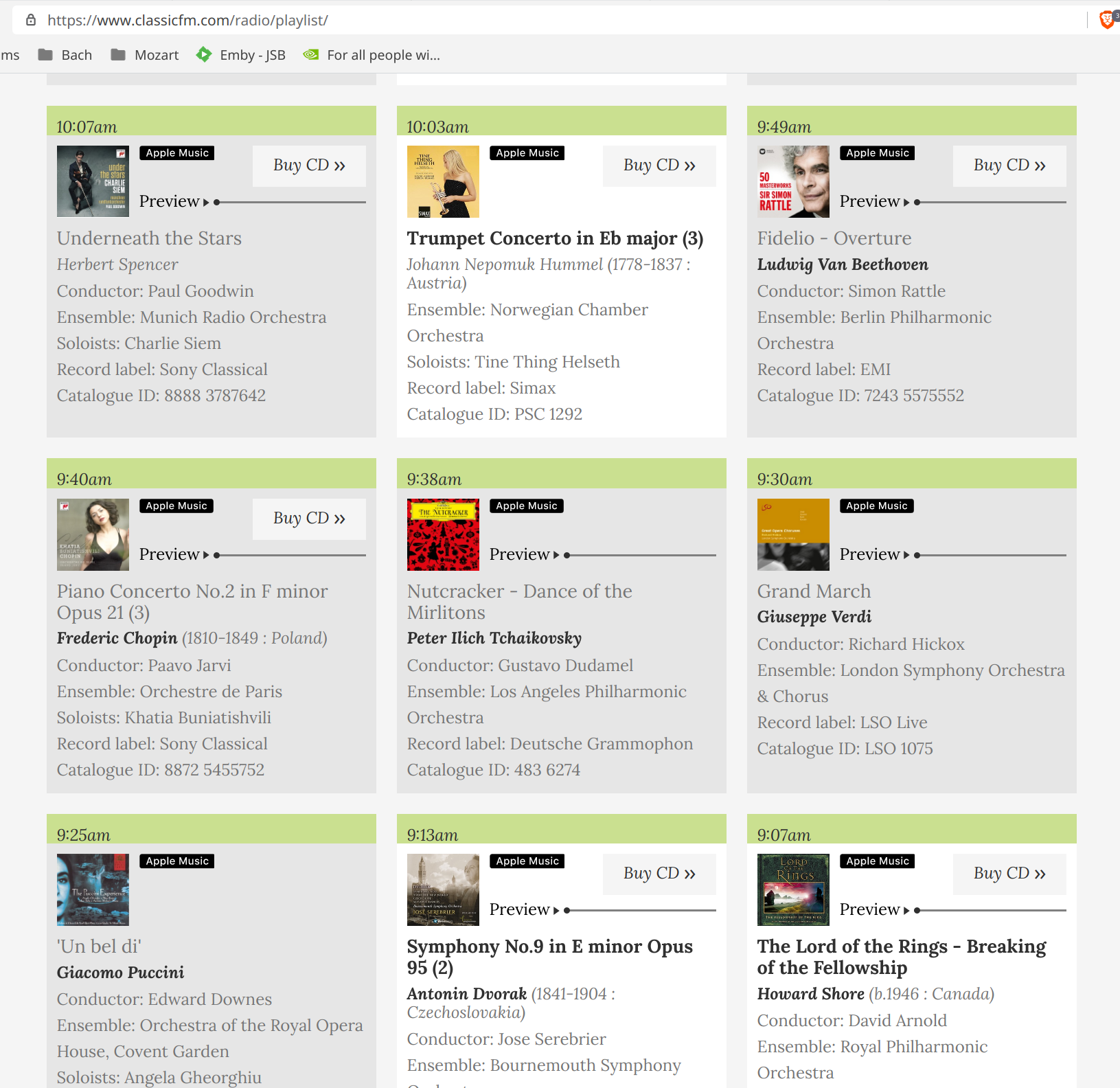
One track from one of the longest film scores ever written; the second movement only of a Dvorak symphony (the one with the good tune!); one aria from Madama Butterfly; a march from Aida; one dance from a ballet; the third movement of a piano concerto; an overture to Beethoven's only opera; the third movement of a trumpet concerto and one track from a 13-track 'medley' compilation CD. There's not a single, serious piece of music played in its entirety there. And 'posh' and 'proper' Radio 3 is often no better, at least in their morning programming:
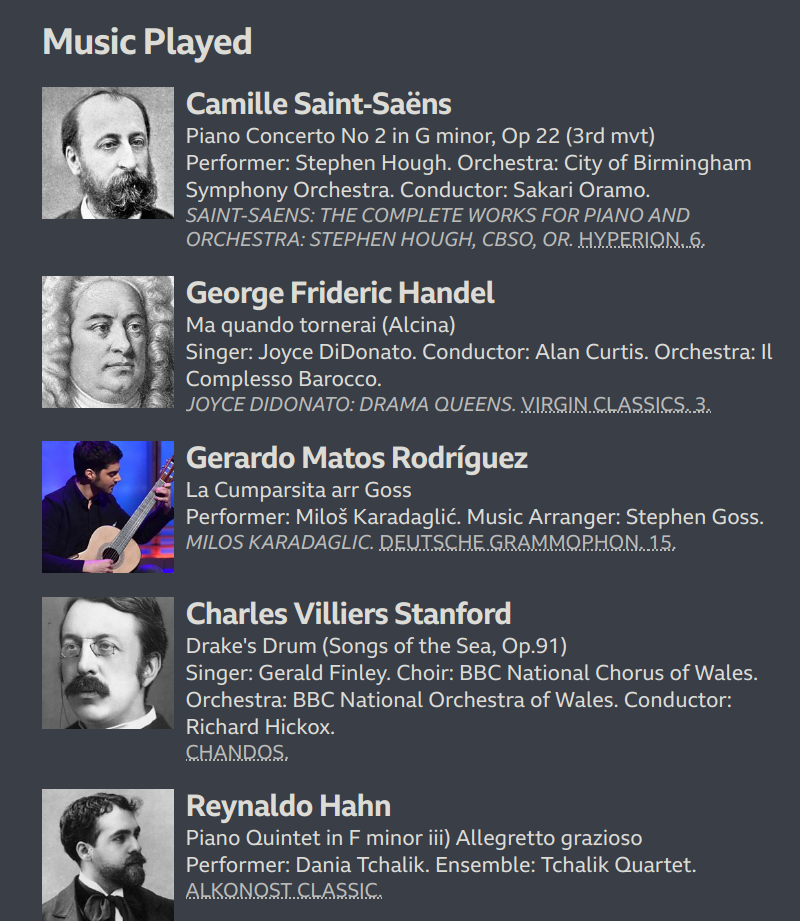
You now get bits and pieces, never whole, complex works. It's as if everyone has decided that whole works are too taxing, too boring, too much like hard work… and yet we expect listeners to somehow switch into 'complex mode' at the drop of a hat any time they venture into the concert hall?! I blame the CD tracks for encouraging this trend!
It was to take a stand against this sort of thing that I made the deliberate design decision to make my own music player play entire folders of music, not tracks. As per my Axioms of Classical Tagging article, specifically Axiom 8, a folder of music is equivalent to and corresponds to a composition, so by only playing complete folders, Giocoso plays complete compositions. You therefore don't get to pick and choose only the good stuff: you have to learn to listen to classical music properly! Do it right in the privacy of your own home, after all, and you'll find it no great shakes to have to do it at the public concert hall.
Of course, we can't all eat everything on our plates all the time :) Sometimes the Brussels sprouts are unappetising and we just fancy tucking in to the chocolate pudding instead. So, whilst Giocoso is a bit of a purist about how you should listen, there's absolutely nothing stopping you from having access to your music via more conventional audio players, too. It's not like I really have to go without, therefore: I have options. But, my default mode of listening now is what Giocoso makes it: complete compositions, no picking and choosing.
The fundamental point to make, I guess, is that whilst I'm definitely a fan of CDs, in the sense that I want to own my music, not rent it, I am not such a fan of the particular way CDs implemented digital classical music. I wish there were fewer tracks. I wish things would be composition-based primarily, with the option to go to specific tracks if really needed. It's for that reason that I also wrote my FLAC tagging manager, Semplice. It has the ability to 'merge' or concatenate per-track FLACs into single, whole-composition FLACs that I've called “SuperFLACs”. These appear on your file system as a single, large FLAC that plays completely as a single 'thing', thereby abolishing the concept of tracks in digital music altogether (though, if you've got the right music player software, the SuperFLAC can still be made to appear as a bunch of virtual, separate tracks, if that's what you prefer).
So, let me sum up what's been a long post.
I like owning music, and I like the click-free, scratchless perfection that digital music provides. So thumbs up for CDs! But when they were introduced, they encouraged a frivolous approach to listening to classical music, because they provided index points within compositions. I think that's a bad thing, so I've written a music player (Giocoso) that ignores tracks and just plays entire folders (i.e., entire compositions), from beginning to end.
I've also written a tagging FLAC manager (Semplice) that, by creating SuperFLACs, abolishes individual tracks as physical entities entirely. Your music is turned into a single, giant file that contains all the data and metadata that was present in the original files, and has an embedded cue sheet so that, if you really insist, and you use an appropriate media player, you can still access individual tracks whilst physically having only one file to manage and look after.
This is a lightly edited version of a blog piece that appeared on AbsolutelyBaching.com in January 2021. It has been updated to make mention of current software developments (Giocoso and Semplice) rather than the now-unsupported code I was writing back in 2021.